Rules & Code of Conduct
Creating a safe and conducive environment for all users.
Last updated on 25 August 2026
Policies
Our vision of a car-lite nation, with amenities to support cycling and walking, must also be accompanied by a culture of graciousness and consideration for others.

Active Mobility Advisory Panel
Set up in 2015, the Active Mobility Advisory Panel (AMAP) guides the safe use of active mobility devices, which include bicycles, power-assisted bicycles (PABs), personal mobility devices (PMDs) and personal mobility aids (PMAs) by reviewing regulations and making recommendations on keeping roads and paths safe for all users.
The Panel plays an active role in engaging various stakeholders studying ways to improve the active mobility landscape, and involving the community as a key partner in this journey. Over the years, AMAP has played a key role in the formulation of the Active Mobility Act, which stipulates device requirements and usage rules for active mobility devices.

Other key recommendations that the AMAP put forth are on-road safety requirements, speed limits for active mobility devices on paths, mandatory third-party liability insurance for businesses, minimum brake requirements for bicycles and the regulation of cargo bicycles, cargo tricycles, rider-only tricycles and recumbents on paths and roads.
More recently, AMAP recommended (i) restricting the use of mobility scooters to be only for those with mobility difficulties, (ii) reducing the speed limit for PMAs from 10km/h to 6km/h, and (iii) harmonising the PMA dimensions for use on public paths and public transport. These recommendations have been accepted by the Government, and took effect on 1 Jun 2026.
Using active mobility devices on shared paths and roads
Effective since May 2018, the Active Mobility Act (AMA) provides a set of rules and code of conduct (opens in new tab) for safe sharing of public paths and roads among the users of:
Bicycles
Power-Assisted Bicycles (PABs)
Motorised and Non-motorised Personal Mobility Devices (PMDs), e.g. kick scooters, electric scooters, hoverboards, unicycles etc.
Personal Mobility Aids (PMAs), e.g. wheelchairs, motorised wheelchairs or mobility scooters designed to carry an individual who has difficulty walking
Find out more about the offences and penalties (opens in new tab), and refer to this useful checklist (opens in new tab) on the rules and guidelines for safe walking and riding on public paths, as well as for cycling on roads.
Regulating active mobility devices
Regulations (opens in new tab) are in place to ensure that the device is safe for use in public, such as the maximum device weight and maximum speed for the various devices as well as where these devices can be used. Power-assisted bicycles and e-scooters also must adhere to prescribed technical standards and have to be registered with LTA.
From 1 Jun 2026, mobility scooters and equivalents must be registered with LTA to be sold. From 1 Jan 2029, all mobility scooters and equivalents must be registered with LTA to be used on public paths.

Mandatory Theory Test (MTT)
Launched on 30 Jun 2021 for e-scooter and PAB riders, the test is intended to ensure that motorised device riders are aware of active mobility rules, code of conduct and safe riding practices. The test, which is available in four languages, can be taken online with special provisions available on a case-by-case basis for those who are not digitally savvy or literate. From 1 Jan 2022, all riders must have passed the test before they are allowed to ride their devices on cycling paths, and roads (applicable to PABs only).
Third-Party Liability Insurance (TPLI)
It is mandatory for operators that provide motorised devices for sharing or which employ workers who use such devices for work to take reasonable and practicable measures to ensure that their riders are adequately covered by third-party liability insurance. Non-commercial riders are strongly encouraged to purchase third-party liability insurance to protect themselves from personal accident expenses and third-party injury claims.
Bringing your active mobility device on public transport
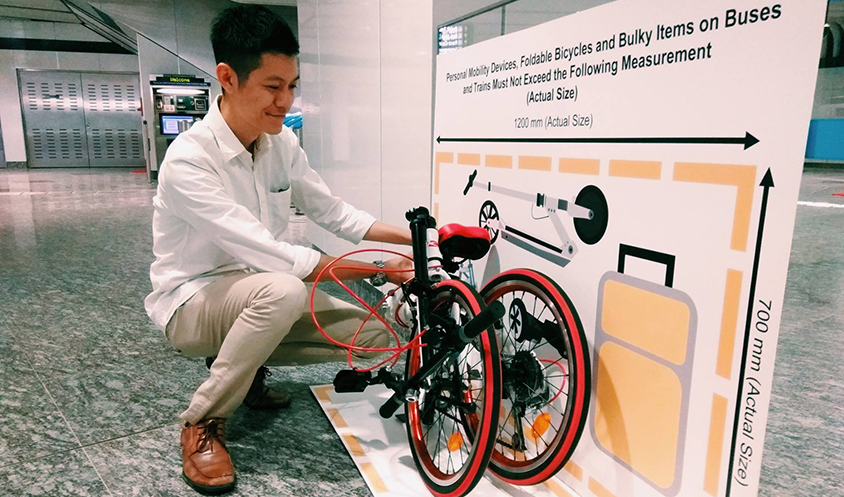
Commuters can bring their active mobility devices onto trains and buses, as long as the device size does not exceed 120cm x 70cm x 40cm. There are size checkers with measurements at most bus interchanges and train stations to help commuters gauge if their device is within the size limit.