
Automated & autonomous vehicles
Learn all about the use of automated & autonomous vehicles in Singapore’s transport system.
Last updated on 13 October 2026
Overview
We are continually improving Singapore’s transport sector with technology to improve the efficiency of moving people and goods. Autonomous vehicles (AVs) will be the next game changer. Deploying AVs on public roads, at airports and sea ports can help further relieve manpower constraints, create good jobs, and move people and goods more efficiently and safely.
-(photo-credit---resort-world-sentosa) (1).png)
Resorts World Sentosa’s Autonomous Shuttle.
Land Transport
AVs are being trialled in Singapore to augment the public transport network.
.jpg)
Deployment of Autonomous Shuttles at Punggol (Photo Credit: Land Transport Authority of Singapore)
Local operators have been running AV fixed-route shuttles in Punggol since September 2025, with rides open to the public since April 2026. These fixed-route shuttles complement the public transport network by bringing residents more directly from residential estates to key amenities (e.g. MRT, polyclinics, etc).
The AVs are easily identifiable and have gone through rigorous safety tests before being deployed and opened for public rides.
LTA is taking a phased and calibrated approach towards the deployment of autonomous buses and is exploring narrower use cases before considering wider, more complex deployment. More details on the use cases and plans will be announced when ready.
We are considering expanding AV deployment to other areas, such as Tuas, Sentosa, and Mandai to meet transport needs of workers and tourists. We are also studying ways to better meet commuters’ transport needs with AVs based on feedback gathered from commuters of ongoing trials.
Having more AVs to augment our public transport network can also create new and better-paying jobs of the future.
.jpg)
Deployment of Autonomous Shuttles at Punggol (Photo Credit: Channel News Asia)
Maritime
Electrified automated yard cranes and unmanned driverless vehicles play a significant role in automating yard and wharf operations at Tuas Port.
At Tuas Port Phase 1, PSA operates the world’s largest fleet of Automated Guided Vehicles (AGVs), which are driverless vehicles that navigate fixed tracks using embedded Radio Frequency Identification (RFID) technology.
For subsequent phases of Tuas Port, PSA will progressively scale up the deployment of next-generation autonomous horizontal transport systems, including Intelligent Guided Vehicles (IGVs). IGVs navigate in a perception-based manner, responding dynamically to the environment in real time based on data from multiple sensors. The IGVs will support large-scale, efficient and resilient operations and allow for mixed-traffic environments where manned and autonomous vehicles can operate alongside each other.
This will enhance our port capabilities and streamline operations to meet the demands of the industry, while freeing up resources and creating more high value jobs for Singaporeans.
-at-tuas-port.jpg)
Automated Guided Vehicles (AGVs) at Tuas Port
Aviation
The development of AVs is critical for Changi Airport to grow and sustain its operations. It will augment the current workforce, and create new jobs for our airport workers who can supervise and control these vehicles remotely from a more comfortable, weather-proof and safe environment. It will also strengthen our operational resilience.
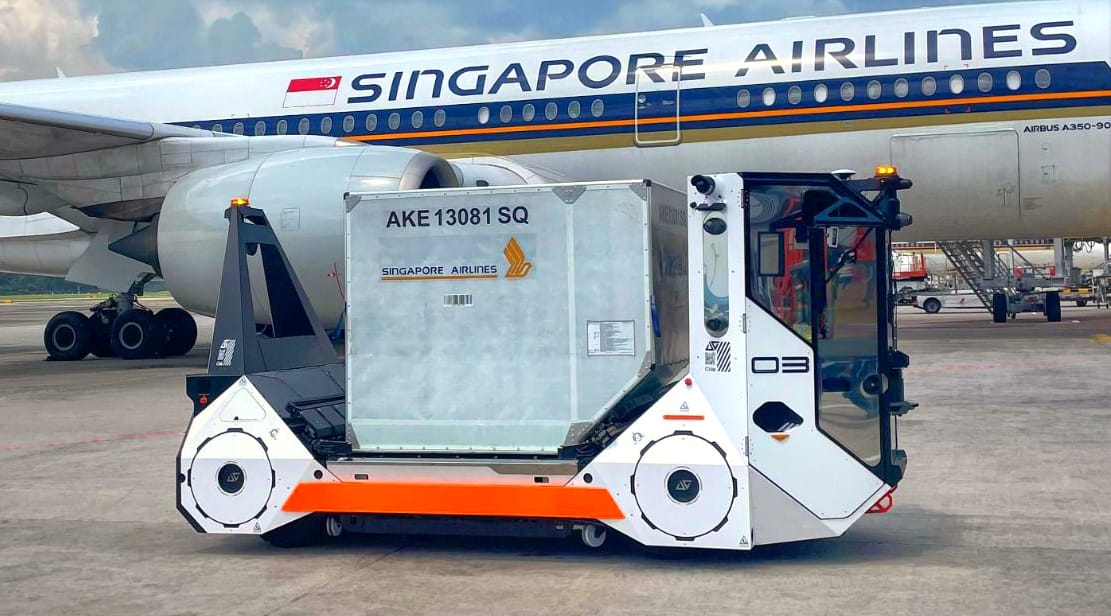
Autonomous baggage tractor trial by Changi Airport Group and Aurrigo International (Photo Credit: Changi Airport Group)
Autonomous baggage tractors are now deployed at Changi Airport. These autonomous baggage tractors help transport baggage between aircraft stands and Baggage Handling Areas. Besides baggage tractors, autonomous shuttle services for the movement of airside workers will also be trialled.
Logistic
AVs are transforming the logistics sector by addressing manpower challenges and enhancing operational efficiency.
FairPrice Group and Zelos Technology have deployed AV logistics vehicles to strengthen supply chain productivity. In addition, driverless robosweepers are on trial by Chye Thiam Maintenance at various locations, helping to boost productivity and address the challenges with the rapidly aging pool of Mechanical Sweepers (MS) drivers.
.png)
Deployment of robosweeper for road sweeping (Photo credit: WeRide)